

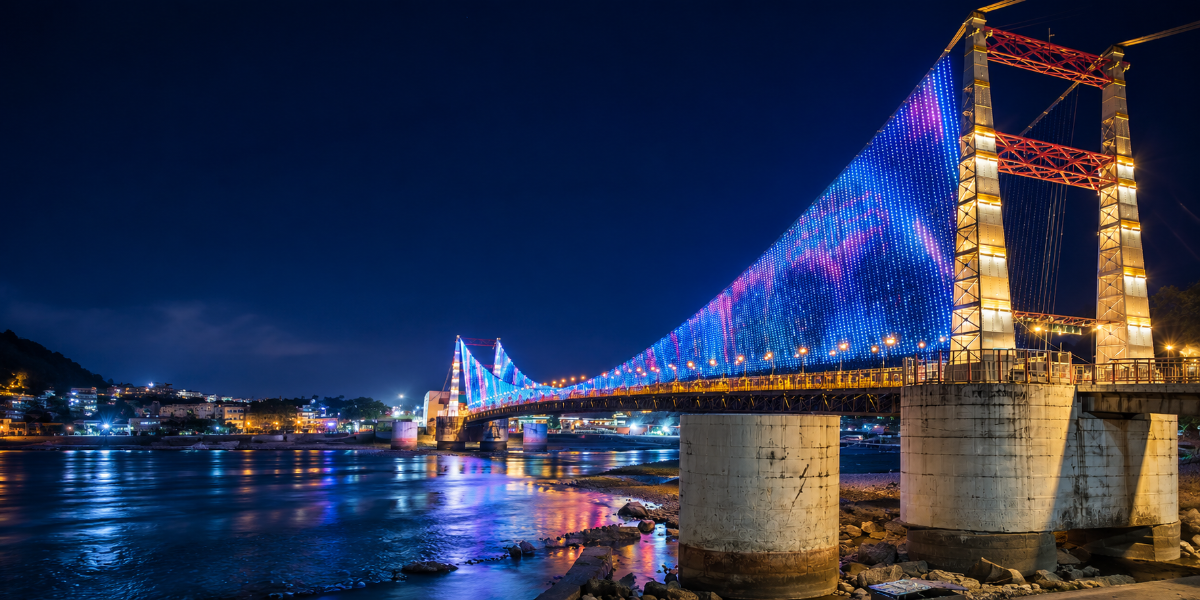

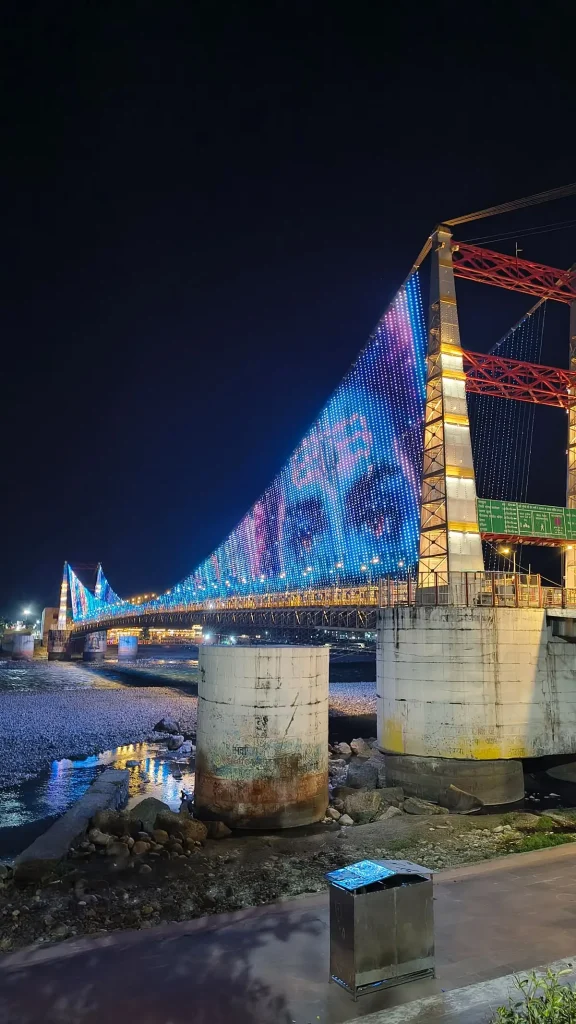
Janki Setu is the newest of Rishikesh’s three suspension bridges over the Ganga, built after the older Laxman Jhula and Ram Jhula to ease growing traffic and pilgrim crowds in the area. Named after Goddess Sita (Janki), the bridge connects the Kailash Gate area near Triveni Ghat to the Swarg Ashram side of the river, close to the Beatles Ashram. This guide covers its history, features, and what’s worth combining with a visit.
History of Janki Setu
Janki Setu was approved in 2013 and re-approved in 2018, with construction completed and the bridge made operational in November 2020, at a total cost of around Rs 48.85 crore. It became Rishikesh’s third suspension bridge over the Ganga, after Laxman Jhula (1930) and Ram Jhula (1986), and was built specifically to reduce crowding on the two older bridges, particularly during the annual Kanwad Yatra pilgrimage season when foot traffic in the area spikes sharply.
Unlike its predecessors, Janki Setu was designed from the outset to be Uttarakhand’s first three-lane suspension bridge with separate lanes for pedestrians and two-wheelers, and a load capacity suited to light vehicle traffic. The bridge has a total length of 346 meters, with a main span of 274 meters across the river.
What Makes Janki Setu Different
Wider, More Modern Design
Where Laxman Jhula and Ram Jhula are narrow and pedestrian-focused, Janki Setu was built with three distinct lanes – one each for incoming and outgoing foot traffic, plus a dedicated lane for two-wheelers and carts. This makes it noticeably less congested than the older bridges, especially during peak pilgrimage season.
A Quieter, Less Crowded Crossing
Because it’s newer and less famous than Laxman Jhula and Ram Jhula, Janki Setu tends to see fewer tourists, making it a more peaceful spot for a slow walk, photography, or simply taking in the view of the Ganga and the Himalayan foothills.
Decorative and Spiritual Touches
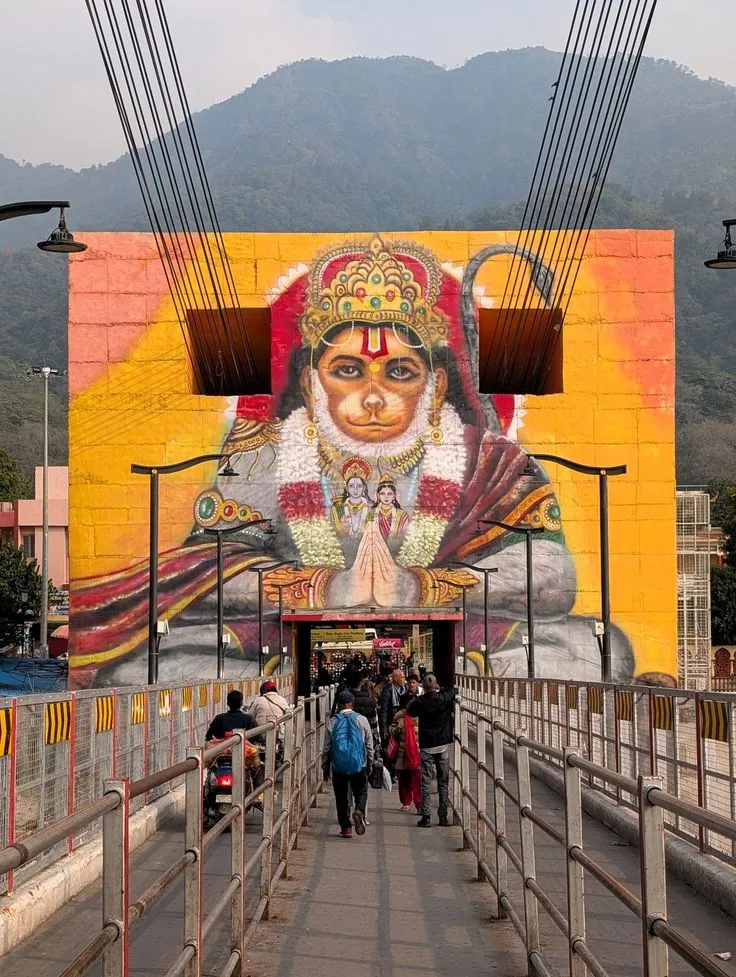
The bridge features artwork and detailing that reflects Hindu mythology, in keeping with its name a nod to Sita, the wife of Lord Rama and adds to the atmosphere for visitors who stop to take in the surroundings rather than just cross.
What’s Near Janki Setu Rishikesh
Beatles Ashram (Chaurasi Kutia)
After crossing Janki Setu, the Beatles Ashram is just a few minutes’ walk away, making the bridge a convenient access point for visitors interested in the site’s connection to the band’s 1968 stay in Rishikesh.
Swarg Ashram and Parmarth Niketan
The Swarg Ashram area, along with Parmarth Niketan and its evening Aarti, is a short walk from the bridge on the opposite bank, making Janki Setu a practical route for visitors moving between the Triveni Ghat side and the ashram cluster.
Route to Neelkanth Mahadev
Travelers heading to the Neelkanth Mahadev Temple can park on the town side near Janki Setu and continue by trek or shared jeep, making the bridge a useful starting point for that route as well.
Triveni Ghat
One of Rishikesh’s most sacred ghats, believed to mark the confluence of the Ganga, Yamuna, and Saraswati rivers, Triveni Ghat is a short walk from Janki Setu and hosts its own evening Ganga Aarti.
Best Time to Visit
October through March offers the most comfortable weather for walking around Janki Setu and the surrounding ghats. Early morning brings a quieter crossing with soft light for photos, while evening closer to the Ganga Aarti at nearby Triveni Ghat or Parmarth Niketan is more lively and atmospheric.
Frequently Asked Questions
1. What is Janki Setu known for?
Janki Setu is Rishikesh’s newest and largest suspension bridge, known for being the first three-lane bridge in Uttarakhand, with separate lanes for pedestrians and two-wheelers, and for offering a quieter alternative to Laxman Jhula and Ram Jhula.
2. When was Janki Setu built?
The bridge was approved in 2013, re-approved in 2018, and became operational in November 2020.
3. What does Janki Setu connect?
Janki Setu connects the Kailash Gate area near Triveni Ghat to the Swarg Ashram side of the river, close to the Beatles Ashram.
4. Is Janki Setu less crowded than Ram Jhula and Laxman Jhula?
Yes. Being newer and wider, with dedicated lanes for pedestrians and two-wheelers, Janki Setu generally sees less congestion than the older bridges, particularly during peak pilgrimage periods.
5. How far is Janki Setu from The Neeraj Ganga Heritage Palace?
The hotel is just a 4-minute drive or a 10-minute walk from Janki Setu, from its location on NH58, Badrinath Highway, Muni Ki Reti.
Where to Stay Near Janki Setu
If you’re planning to explore Janki Setu and the Beatles Ashram, staying in Muni Ki Reti keeps you within easy reach of both, along with Ram Jhula, Bajrang Setu, and Parmarth Niketan. The Neeraj Ganga Heritage Palace, widely regarded as the best hotel near Janki Setu, offers Ganga-facing rooms and an in-house multi-cuisine restaurant, centrally placed for exploring Rishikesh’s full stretch of bridges and ghats.
Distance from The Neeraj Ganga Heritage Palace
The Neeraj Ganga Heritage Palace, located on NH58, Badrinath Highway in Muni Ki Reti, is just a 2-minute drive or about a 5-minute walk from Janki Setu making it one of the closest hotels to Janki Setu for travelers who want to walk rather than commute. It’s a similarly convenient distance to Ram Jhula and Bajrang Setu, making the hotel a practical base for visiting all three bridges without relocating.
For anyone comparing the best hotels near Janki Setu, this proximity is worth factoring in directly a 5-minute walk versus a 15 – 20 minute drive changes how much of your day you actually spend sightseeing versus commuting between locations.
Experience The Neeraj Ganga Heritage Palace
Staying at The Neeraj Ganga Heritage Palace isn’t just about a rooms near Janki Setu – it’s about what’s included in the stay itself. The property offers Ganga-view rooms and suites across multiple categories, from the Maharaja Suite to standard Deluxe Rooms, many with private balconies that look directly out over the river rather than a partial or distant view.
Guests get access to an in-house multi-cuisine restaurant, Naivedyam Bhog, along with Sky Cafe for a more relaxed, riverside coffee-and-conversation setting – useful given that dining options thin out once you move away from the main market areas. The hotel also arranges a personalized Ganga Aarti experience for guests who’d rather skip the crowds at the main public ceremony.
The view extends beyond the room itself, too – Parmarth Niketan is visible right across the river from The Neeraj Ganga Paradise, giving guests a direct line of sight to the ashram and its evening Aarti even before stepping outside.
What ties the whole stay together is the location itself: with Janki Setu just a 5-minute walk away, guests can see Janki Setu without needing transport, and the same applies to Ram Jhula nearby. For travelers who want their sightseeing and their accommodation to feel like one connected experience rather than two separate parts of the trip, that walkability is what defines a stay here more than any single amenity.